
Tyres
The EU Tyre Label Explained: What A, B and C Actually Mean
The EU tyre label explained in plain English. What the fuel letter, the wet grip letter and the decibel figure are measuring, and which one to care about.
9 min read
Every tyre sold in the UK and the EU carries the same label, and almost nobody reads it. It is three pieces of information, it is genuinely useful, and it takes about a minute to learn.
Here is the EU tyre label explained without the jargon: what each rating actually measures, what the difference between two letters is worth in real terms, and which of the three is worth paying for.
What the label looks like
This is a real label, pulled live from the official EU register for a tyre currently on sale. It is the same label you will see on the tyre page when you compare prices here.
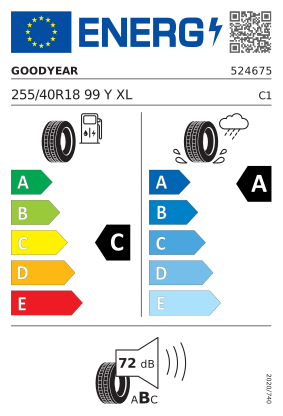
A real registered label. Fuel efficiency C, wet grip A, external noise 72 decibels in class B. Every tyre on sale has one of these, and the register is public.
Three ratings, and they are independent of each other. A tyre can be excellent at one and mediocre at another, which is exactly why the label is worth a glance rather than a guess.
The first letter: fuel efficiency
The top rating measures rolling resistance, which is how much energy the tyre wastes as it deforms and recovers thousands of times a minute. Less waste means less fuel, or more range in an electric car.
It is graded A to E. The steps are not decorative: the gap across the full scale is worth a meaningful percentage of your fuel bill over the life of a set, and the gap between adjacent letters is small but real.
This is the rating that pays you back slowly. It matters most if you cover a lot of motorway miles, and it matters more on an electric car than on a petrol one, because rolling resistance is a larger share of the total energy used when there is no engine wasting heat.
The second letter: wet grip
The second rating is wet braking, measured as how quickly the tyre stops on a wet surface from a set speed. It is also graded A to E.
This is the one that matters most, and it is not close. The difference between an A and a lower grade is measured in metres of stopping distance from motorway speed, and metres are the difference between a near miss and a claim. Every other consideration on the label is about money. This one is about whether you stop in time.
If you take one thing from the label, take this: do not trade wet grip for a better fuel letter. The fuel saving is pennies a week. The braking difference arrives all at once, on the one day it matters.
The number: external noise
The third figure is a decibel measurement with a class beside it. It is measured outside the car as it passes, not inside the cabin, which is why the number can feel disconnected from what you hear.
It is still a fair comparison between two tyres of the same size, because a tyre that is quieter outside is generally quieter inside too. Decibels are a logarithmic scale, so a few points is a larger difference than it looks on paper.
Noise matters more than it used to because cars have got quieter. In an electric car the tyres are often the loudest thing about the vehicle at any speed above walking pace, so the difference between a noisy tyre and a quiet one is something you live with every day.
The trio, side by side
Here are the same three ratings shown as the compact icons you will see beside a tyre when comparing, with the official colour scale: green is best, orange is worst.
The same tyre in compact form. Read it left to right: fuel, wet grip, noise.
When you are comparing several tyres in the same size, this is the view that does the work. The letters are directly comparable because every tyre is tested to the same standard, which is the entire point of the label existing.
What the label does not tell you
The label is deliberately narrow, and knowing its limits is part of reading it properly.
- It says nothing about dry grip, which is not tested at all.
- It says nothing about how long the tyre will last, which is often the biggest cost difference between two options.
- It says nothing about comfort, steering feel or how the tyre behaves at the limit.
- It says nothing about snow or ice performance. That is a separate marking on the sidewall, not part of the label.
- It is measured on a new tyre, so it describes the tyre you buy rather than the tyre after three winters.
This is why independent tyre tests still exist and are still worth reading. The label tells you three measured facts. It does not tell you whether the tyre is any good.
The snowflake marking, which is not on the label
You will also see a small mountain-and-snowflake symbol on some sidewalls. That is the three peak mountain snowflake marking, and it certifies genuine severe-snow performance.
It is a separate certification with its own test, and it is the marking that matters where winter tyres are legally required or seasonally sensible. A tyre labelled all-season without that symbol has not passed the snow test, whatever the marketing says.
How to actually use it when buying
A practical order of priority, for a normal car driven on normal roads.
- Confirm the size, load index and speed rating match what your car requires. This is not negotiable and it comes before the label entirely.
- Look at wet grip and treat it as close to a minimum standard rather than a preference.
- Use the fuel letter to separate two otherwise similar options, especially if you drive a lot or drive electric.
- Use the noise figure to break a genuine tie, and weight it more heavily if your car is quiet.
- Then read an independent test for longevity and feel, because the label will not tell you either.
The register is public, so you can look up any tyre's label yourself before you buy. That is unusual in car parts, and it is worth using.
Common questions
What do the letters on a tyre label mean?
The first letter grades fuel efficiency, which is how much energy the tyre wastes as it rolls. The second grades wet braking. Both run A to E, with A best. The separate number is external noise in decibels, measured outside the car as it passes.
Which tyre rating is most important?
Wet grip, and it is not a close call. The difference between grades is measured in metres of wet stopping distance from motorway speed. The fuel rating saves you money slowly; the wet grip rating matters all at once, on the day it matters.
Is an A-rated tyre worth the extra money?
For wet grip, generally yes, because you are buying stopping distance. For fuel efficiency it depends on your mileage: the saving is real but gradual, so it repays high-mileage and electric drivers faster than someone doing short local trips.
Does the tyre label tell you how long a tyre lasts?
No, and that is its biggest limitation. Tread life is often the largest cost difference between two tyres and it is not measured on the label at all. For that you need an independent tyre test rather than the label.
Where does the label information come from?
Manufacturers register each tyre in the official EU product database and the label is generated from that entry. The register is public, so the label shown against a tyre can be checked against the source rather than taken on trust.
Read more like this
Tyres
Can a Punctured Tyre Be Repaired, or Does It Need Replacing?
Can a punctured tyre be repaired? There are clear rules, and where the nail went decides it more than how big the hole is. Here is how to know before you call.
Tyres
How Long Do Tyres Last? Mileage, Age and What Shortens Both
How long do tyres last? Mileage varies enormously with driving and car, and age matters separately. Here is what decides it, and what you can change.
Tyres
How to Check Tyre Tread Depth, and What the Tyre Is Telling You
How to check tyre tread depth with a coin, where to look, and how to read the wear pattern. Uneven wear is a symptom, and it names the fault.
Need tyres or a service?
Search by registration or size, compare fitted prices from local specialists, and book with the price locked in.
Find tyres