
Diagnose it
Why Are My Back Tyres Wider Than the Front?
Why are my back tyres wider than the front is a fair question, and the answer is that on some cars it is the design and on others it is a mistake. Here is how to tell which you are looking at.
6 min read
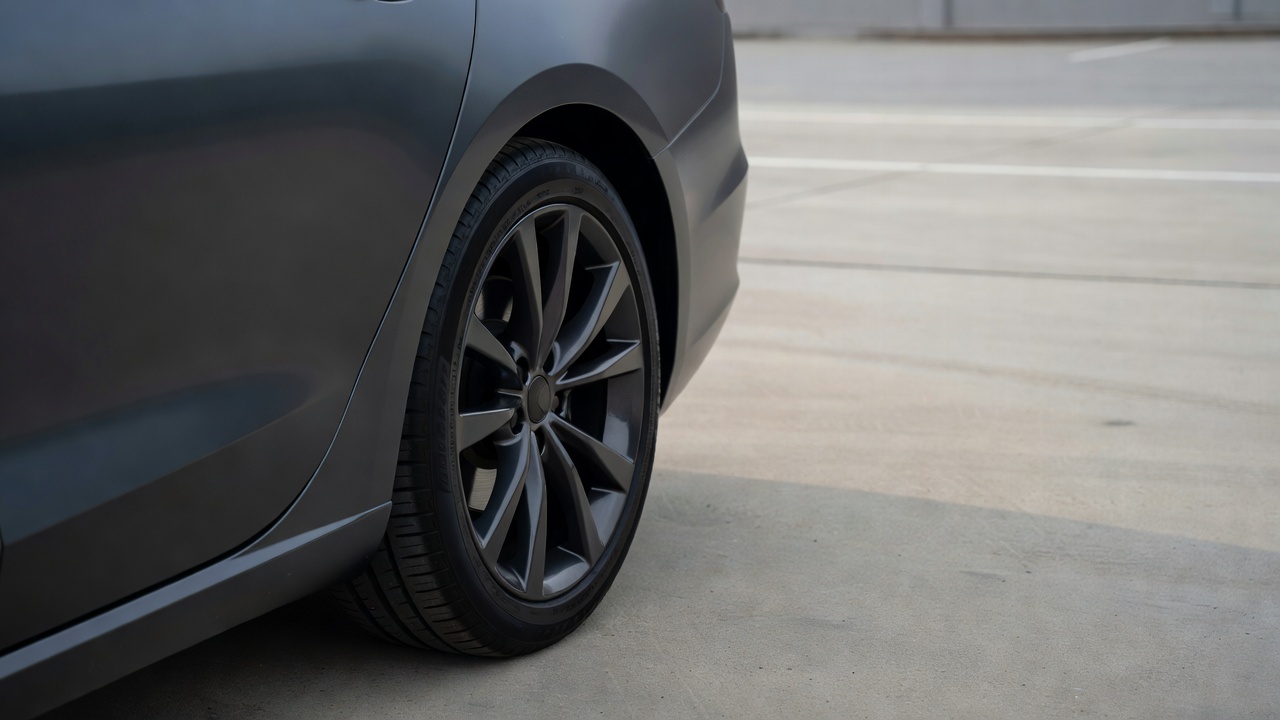
You crouch down to check your tyre pressures, glance from one end of the car to the other, and something looks off. The back tyres are visibly fatter than the front ones. Before you assume someone has fitted the wrong rubber, it is worth knowing that on a good number of cars this is exactly how the manufacturer intended it.
The industry calls it a staggered fitment. If you have found yourself asking why are my back tyres wider than the front, the likely answer is that the car was built that way: it is common on rear-wheel-drive cars, most performance cars, and a growing number of electric ones. It is also occasionally the result of a mistake at a previous fitting. Telling those two situations apart takes about two minutes and costs nothing.
How to check whether yours are supposed to be different
Every tyre carries its size on the sidewall, in a format like 225/40 R18. The first number is the width in millimetres, so a 255 is wider than a 225. Read the size off one front tyre and one rear tyre and write both down.
Now find what the car was built with. There are three reliable places to look, and they should agree with each other:
- The tyre placard, usually a sticker inside the driver's door shut, sometimes inside the fuel filler flap or the glovebox lid. It lists the sizes and the pressures.
- The owner's handbook, which will list the approved sizes including any optional wheel packages.
- The vehicle registration document in some markets, which records the approved fitments.
If the placard lists two different sizes, one for the front axle and one for the rear, your car is a staggered fitment and everything is as it should be. If the placard lists one size and your rear tyres are wider than that, something has been changed.
Why manufacturers do it on purpose
On a rear-wheel-drive car, the back tyres do two jobs at once. They put the engine's power down and they carry a large share of the cornering load. The front tyres only steer. Giving the rear axle more contact patch is a straightforward way to balance the two ends so the car behaves predictably when you accelerate out of a bend.
There is a handling reason as well. A car with wider rear tyres tends towards understeer at the limit, meaning the front loses grip first and the car runs wide. That is easier for most drivers to recognise and correct than the alternative, where the back steps out. Manufacturers generally prefer the version that is easier to catch.
Electric cars have brought a newer reason. They are heavy, and they deliver their torque instantly from a standstill. A wider rear tyre spreads that weight and that shove over more rubber, which helps both traction and wear.
When wider rear tyres are a problem
The problem is not the width itself. It is width that the car was not designed around. If your placard lists one size for all four corners and someone has fitted wider tyres at the back, a few things follow.
The speedometer and odometer read from wheel speed, so a different rolling circumference at the driven axle can shift the readings. On a car with electronic stability control, the system compares wheel speeds to work out what the car is doing; feeding it mismatched sizes it was never calibrated for is not something to shrug at. And on all-wheel-drive cars the tolerance is tighter still, because a persistent speed difference between axles puts load through the centre differential or coupling that it was not built to absorb.
There is also the practical annoyance. Non-standard sizes are harder to source, and if you damage one you may find yourself waiting rather than driving.
What staggered tyres change about replacing them
The rule everyone knows, replace tyres in pairs across an axle, still applies. What changes is that you can no longer move tyres between the front and rear to even out wear, because they are different sizes. Rotation is off the table unless the car has an unusual same-size arrangement with different offsets.
The practical effect is that the rear tyres on a staggered car usually wear out first, sometimes considerably faster on a powerful rear-drive car. You end up buying rears more often than fronts, and that is normal rather than a sign of a fault.
Two habits make the difference last longer. Keep the pressures right, because an underinflated tyre wears at the shoulders and runs hot. And have the alignment checked if you notice the wear going uneven across the tread rather than evenly all over, since a rear axle out of alignment will chew through the more expensive pair.
One thing worth saying plainly: if the tyres on the same axle are different from each other, in size, brand, tread pattern or wear, that is a different situation and worth getting looked at rather than living with. Matching across an axle matters more than matching front to back.
Directional and asymmetric tyres add one more thing to check
Many performance tyres are directional, meaning they are built to turn one way and carry an arrow on the sidewall showing which. Others are asymmetric, with an outer shoulder designed to face outwards, marked outside or inside on the sidewall.
On a staggered car this catches people out, because you cannot solve a directional tyre fitted on the wrong side by swapping it to the other axle. It has to come off the rim and go back on the right way round. It is worth a glance at the sidewall next time you are checking pressures; the arrow is easy to read and a tyre running backwards loses a meaningful amount of wet grip.
The short version
Read the size on the sidewall, compare it with the placard in the door shut, and you will know within two minutes whether your wider rear tyres are the design or somebody's decision. If they match the placard, nothing is wrong and you simply have a car that will need rear tyres more often. If they do not match, it is worth asking a fitter to look before the next long trip, particularly on an all-wheel-drive car.
Common questions
Is it illegal to have different tyre sizes front and back?
Not in itself. Many cars leave the factory with different sizes on each axle, and that is entirely legal. What matters is that the sizes match what the manufacturer approved for the car, and that the two tyres on the same axle match each other. Rules differ by market, so check the local requirement if you are unsure.
Can I put the same size on all four corners instead?
Only if the manufacturer approves that size for both axles, which is sometimes the case where a car offers more than one wheel package. If it does not, you are changing something the car's stability and drive systems were calibrated around. Ask a fitter to check the approved fitments for your exact model before deciding.
Why do my rear tyres wear out so much faster?
On a rear-wheel-drive car the back tyres both transmit the power and take a large share of the cornering load, so they simply do more work. Faster rear wear is normal. What is not normal is uneven wear across the width of the tread, which usually points at pressures or alignment.
Can staggered tyres be rotated?
Generally no, because the front and rear tyres are different sizes and cannot swap places. Some owners swap left for right on the same axle, but that only works on non-directional tyres. If yours have an arrow on the sidewall, they are directional and cannot simply change sides.
Read more like this
Diagnose it
Burning Smell From Car? What Each One Usually Means
A burning smell from car vents or under the bonnet has a handful of likely causes, and they are not equally urgent. Here is how to tell which one you probably have.
Diagnose it
Car Air Conditioning Not Cold? What That Usually Means
Car air conditioning not cold any more? It rarely breaks suddenly. It fades, and the way it fades tells you whether this is a refrigerant job or something else.
Diagnose it
Car Pulls to One Side? Work Through It in This Order
When a car pulls to one side the causes run cheap to expensive in a predictable order. Here is how to work through them without paying for the wrong one.
Need tyres or a service?
Search by registration or size, compare fitted prices from local specialists, and book with the price locked in.
Find tyres