
Tyres
Can a Punctured Tyre Be Repaired, or Does It Need Replacing?
Can a punctured tyre be repaired? There are clear rules, and where the nail went decides it more than how big the hole is. Here is how to know before you call.
8 min read
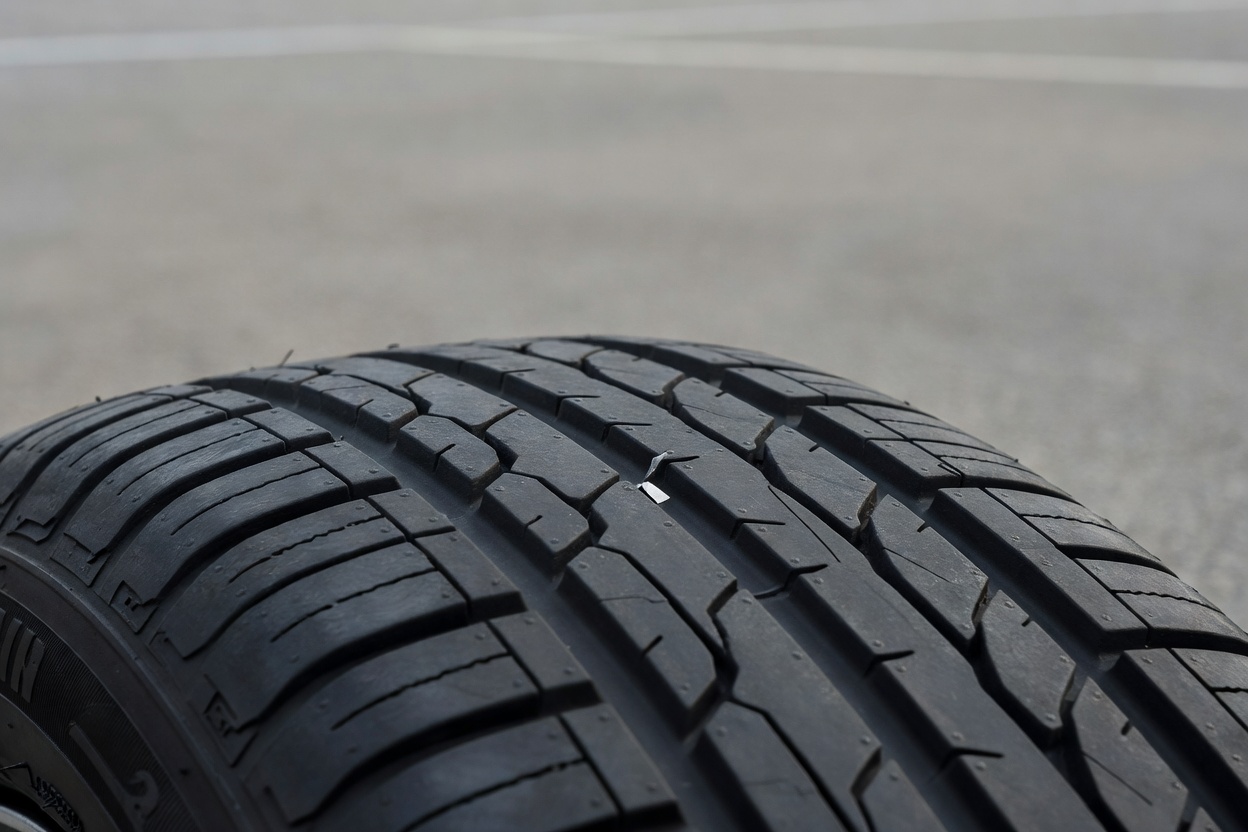
There is a nail in your tyre. It is not flat yet, or it went down overnight and you have pumped it up, and now you want to know whether this is a small bill or a large one.
Can a punctured tyre be repaired is a question with real rules behind it rather than a matter of opinion. The two things that decide it are where the damage is and what has happened since, and you can assess both yourself before anyone quotes you.
Where the damage is matters more than how big it is
A tyre is not uniform. The central part of the tread has steel belts behind it and is the strongest area. The shoulders and the sidewall flex constantly as the tyre rolls and carry the load, and no repair holds reliably in rubber that is flexing that much.
So the rule everyone in the trade works to is that repairs are permitted only in a defined central band of the tread, and never in the shoulder or the sidewall. That is why a tiny neat hole low on a sidewall means a new tyre while a larger one in the middle of the tread is a routine repair.
Look at where your nail actually is before you assume anything. If it sits in the central area between the main grooves, you are probably fine. If it is out near the edge, expect a replacement and be sceptical of anyone who offers otherwise.
The other conditions
Position is the first test. A few more have to be true as well.
- The hole has to be within a maximum diameter. Beyond that, a repair cannot restore the structure.
- The tyre must not have been driven on while flat. Running deflated damages the internal casing invisibly, and that damage does not go away when the tyre is reinflated.
- There must be enough tread left to justify it. Repairing a tyre with weeks of life remaining is money you will spend again shortly.
- The tyre must not already carry an incompatible repair, or damage elsewhere.
- It must not be a run flat that has been driven on deflated, which most manufacturers exclude outright.
The driven-on-flat condition is the one that catches people, because it is the natural thing to do. Getting home on a flat tyre often converts a repairable puncture into a replacement.
What a proper repair actually involves
This is worth knowing because it explains why the roadside options are not the same thing.
A correct repair means removing the tyre from the wheel and inspecting the inside. That inspection is the point: it is the only way to see whether the object did more damage on its way in, and whether the tyre has been run soft. The hole is then prepared and sealed from the inside, plugging the hole and covering it in one, so air cannot track along the puncture path.
An external plug pushed in without removing the tyre skips the inspection entirely. It may hold air. It tells you nothing about the state of the casing, which is the part that matters at speed.
Sealant cans and what they cost you
Many cars now carry a sealant kit instead of a spare, and it is genuinely useful. It gets you moving and it is far better than being stranded.
It is worth understanding the trade though. Sealant coats the inside of the tyre, and it can make a subsequent proper inspection and repair harder or impossible depending on the type and how long it has been in there. It also has an expiry date that almost nobody checks, and an expired can is a can that does not work on the night you need it.
Use it to get somewhere safe. Then tell whoever looks at the tyre that sealant has been used, so they are not surprised when they break the bead.
If it is going down slowly and there is no nail
A tyre losing pressure over days with nothing visible in the tread is a slightly different problem, and it is often not the tyre at all.
- A corroded wheel rim where the tyre seals against it, common on older alloys and on cars used through salted winters.
- A faulty or corroded valve, which is inexpensive and easily missed.
- A pressure sensor valve nearing the end of its life on cars with monitoring.
- A very small object still embedded and sealing itself while stationary.
- Simple seasonal pressure loss as temperatures fall, which is not a leak at all.
That last one is worth ruling out first in autumn. Air contracts as it cools, so all four tyres reading low at once in November is usually weather rather than four punctures.
Should you repair it, even if you can?
A properly done repair in the correct area is a legitimate, permanent fix, and it is not a compromise you have to feel uneasy about.
There are two situations where replacing makes more sense anyway. One is a tyre already well worn, where you are paying to extend something nearly finished. The other is where the tyre is one of a pair with quite different wear, since matching across an axle matters for handling and, on some cars, for the drivetrain.
Otherwise, repair. It is cheaper, it is quicker, and throwing away a serviceable tyre has a cost of its own.
What to do in the next ten minutes
- Do not pull the nail out. It is currently sealing the hole and it also marks the spot.
- Check the pressure and reinflate to the correct figure if you can.
- Look at where the damage sits: central tread, or shoulder and sidewall.
- If it holds pressure, drive gently and directly to somewhere that can look at it.
- If it will not hold pressure, do not drive on it flat. That decision is what usually turns a repair into a replacement.
Photograph the position before you go. It saves explaining, and it means the answer you get over the phone is based on the same thing you are looking at.
Common questions
Can a punctured tyre be repaired?
Often yes, if the damage sits within the central band of the tread, the hole is within a permitted size, the tyre has not been driven on flat and there is meaningful tread left. Damage in the shoulder or sidewall is never repairable, whatever its size.
Why can't a sidewall puncture be repaired?
The sidewall flexes constantly as the tyre rolls and carries the load, and no repair holds reliably in rubber flexing that much. The central tread has steel belts behind it, which is why it is the only area where a repair is permitted.
Should I pull the nail out?
No. While it is in place it is partly sealing the hole and it marks the exact position, both of which help. Pulling it out usually turns a slow leak into a flat tyre in the place least convenient to you.
Does using a sealant can stop the tyre being repaired?
It can make a proper inspection and repair harder or impossible, depending on the sealant and how long it has been in. It is still the right call to get somewhere safe, but mention it when you hand the car over.
Can a run flat tyre be repaired after a puncture?
Usually not, if it has been driven on while deflated. The reinforced sidewall carries the car under a load it was not designed for, and the resulting internal damage is invisible from outside, so most manufacturers require replacement.
Read more like this
Tyres
The EU Tyre Label Explained: What A, B and C Actually Mean
The EU tyre label explained in plain English. What the fuel letter, the wet grip letter and the decibel figure are measuring, and which one to care about.
Tyres
How Long Do Tyres Last? Mileage, Age and What Shortens Both
How long do tyres last? Mileage varies enormously with driving and car, and age matters separately. Here is what decides it, and what you can change.
Tyres
How to Check Tyre Tread Depth, and What the Tyre Is Telling You
How to check tyre tread depth with a coin, where to look, and how to read the wear pattern. Uneven wear is a symptom, and it names the fault.
Need tyres or a service?
Search by registration or size, compare fitted prices from local specialists, and book with the price locked in.
Find tyres