
Tyres
Should You Replace Tyres in Pairs, or Is One Enough?
Should you replace tyres in pairs? Sometimes one is fine, sometimes it risks the drivetrain. Here is what decides it, and where the new pair should go.
8 min read
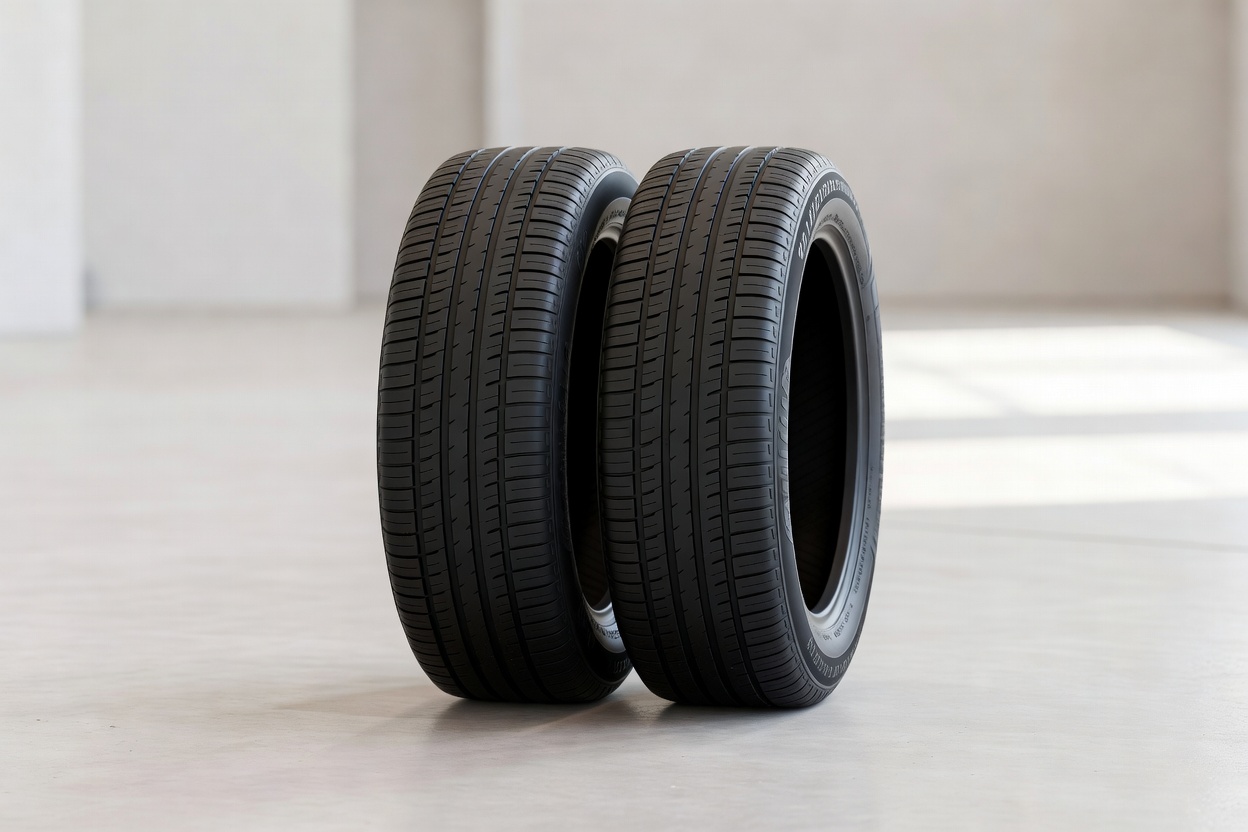
One tyre has picked up damage that cannot be repaired. The other three are fine. You are now being told you need two, and it is reasonable to wonder whether that is advice or salesmanship.
Should you replace tyres in pairs is one of those questions where the answer genuinely depends on your car, and on how different the remaining tyres are. Sometimes one is perfectly fine. On some cars, fitting one is an expensive mistake.
The general principle
Tyres on the same axle should be as similar as possible: same size, same construction, ideally the same model, and reasonably close in tread depth.
The reason is that the two tyres on an axle share the work. If one grips noticeably better than the other, braking and cornering become asymmetric, which shows up as a pull under braking or as the car behaving differently turning left and right. It is not usually dramatic, but it is real.
So mixing across an axle is the thing to avoid. Having different tyres front and rear is far less of a concern, provided each pair matches.
When one tyre is genuinely fine
If your other tyres still have most of their tread, replacing a single damaged one is perfectly reasonable.
A new tyre alongside one that is barely worn is close enough in diameter and grip that the difference is negligible. Match the size, load index, speed rating and, where you can, the model, and you have not compromised anything.
The situation to avoid is a brand new tyre next to one near the end of its life. The difference in tread depth means a real difference in wet grip, and on the same axle that is worth avoiding even on an ordinary car.
When four-wheel drive changes the answer
This is the case where the advice stops being about grip and starts being about hardware, and where ignoring it gets expensive.
A tyre with more tread has a marginally larger rolling diameter, so it turns slightly slower than a worn one covering the same ground. On a two-wheel-drive car nothing minds. On many four-wheel-drive and all-wheel-drive systems, that permanent difference is absorbed by a differential or a coupling that was never designed to work continuously, and it can wear or damage it.
Manufacturers of such cars usually specify a maximum permitted difference in circumference or tread depth across the car, not just across an axle. Some recommend replacing all four. If you have four-wheel drive, check what your handbook says before deciding, because this is the one scenario where the cheaper option can cost you a drivetrain component.
Where the new pair should go
This one surprises people, and it is worth getting right: when you fit two new tyres, they should generally go on the rear.
The reasoning is about what happens when grip runs out. If the front tyres let go first, the car pushes wide, which is unsettling but relatively intuitive to correct by easing off. If the rear lets go first, the back steps out, and recovering that is much harder for most drivers. Putting the better tyres at the back makes the car lose grip at the front first, which is the more manageable failure.
It applies to front-wheel-drive cars too, where the fronts wear faster and people instinctively want the new pair on the driven axle. It is counterintuitive and it is still the safer arrangement.
Mixing brands, patterns and seasons
A few distinctions worth keeping separate.
- Different brands on the same axle: not ideal, and acceptable if the size and ratings match and the tread depths are close.
- Different tread patterns on the same axle: worse, because wet behaviour differs more than the numbers suggest.
- Summer and winter tyres mixed on the same axle: avoid. The compounds behave differently enough at any given temperature to matter.
- Winter tyres on only one axle: avoid. Winter grip at one end and summer grip at the other is exactly the imbalance you do not want.
- Run flats mixed with ordinary tyres: avoid, as the sidewall stiffness differs substantially and changes how the car handles.
If budget means fitting winter tyres to only two wheels, the honest answer is that a full set later is better than a half set now.
How to decide in the moment
- Check whether the car is four-wheel drive. If it is, read the handbook before anything else.
- Measure the tread on the other tyre on the same axle. Close to the new one means one is fine; a large gap means two.
- Match size, load index and speed rating exactly, whatever else you do.
- If fitting two, ask for them on the rear and have the old rears moved forward if they are the better pair.
- If two of the four are near the limit anyway, doing all four at once often costs less than two now and two shortly.
That last point is worth pricing rather than assuming. A set is frequently discounted in a way two are not, and it removes the mismatch question entirely.
What to be sceptical of
Being told you need two when your other tyre is nearly new deserves a question, and a straight answer should be easy to give.
Ask what the tread depth is on the other tyre on that axle, and ask for the figure rather than an opinion. If the difference is small and the car is two-wheel drive, one tyre is a legitimate choice and nobody should struggle to say so.
Equally, if you have four-wheel drive and someone offers to fit a single tyre without mentioning the circumference tolerance, that is worth pausing on too. The advice can be wrong in both directions.
Common questions
Should you replace tyres in pairs?
Not always. If the other tyre on the same axle still has most of its tread, replacing one is fine. If there is a large difference in tread depth, fit two, because braking and cornering become asymmetric across an axle with mismatched grip.
Can I replace just one tyre on a four-wheel-drive car?
Check the handbook first. Many four-wheel-drive systems specify a maximum permitted difference in circumference across the car, because a permanent mismatch is absorbed by a differential or coupling that was not designed for it. This is the case where the cheap option can cost a drivetrain component.
Should new tyres go on the front or the back?
Generally the back, even on a front-wheel-drive car. Better grip at the rear means the car loses grip at the front first, which pushes wide and is far easier to correct than the back stepping out.
Can I mix tyre brands?
Across the car, yes. On the same axle it is not ideal but acceptable if size and ratings match and tread depths are close. Mixing tread patterns on one axle is worse, and mixing summer and winter compounds on one axle should be avoided.
Is it cheaper to replace all four at once?
Often, yes, if two are already near the limit. A full set is frequently discounted in a way two are not, and it removes the mismatch question entirely. It is worth pricing rather than assuming.
Read more like this
Tyres
Can a Punctured Tyre Be Repaired, or Does It Need Replacing?
Can a punctured tyre be repaired? There are clear rules, and where the nail went decides it more than how big the hole is. Here is how to know before you call.
Tyres
The EU Tyre Label Explained: What A, B and C Actually Mean
The EU tyre label explained in plain English. What the fuel letter, the wet grip letter and the decibel figure are measuring, and which one to care about.
Tyres
How Long Do Tyres Last? Mileage, Age and What Shortens Both
How long do tyres last? Mileage varies enormously with driving and car, and age matters separately. Here is what decides it, and what you can change.
Need tyres or a service?
Search by registration or size, compare fitted prices from local specialists, and book with the price locked in.
Find tyres