
Servicing
Coolant and Antifreeze Explained: Why the Colour Matters
Coolant is not just antifreeze, and the colours are not interchangeable. Here is what it actually does, why it expires, and why mixing types is expensive.
8 min read
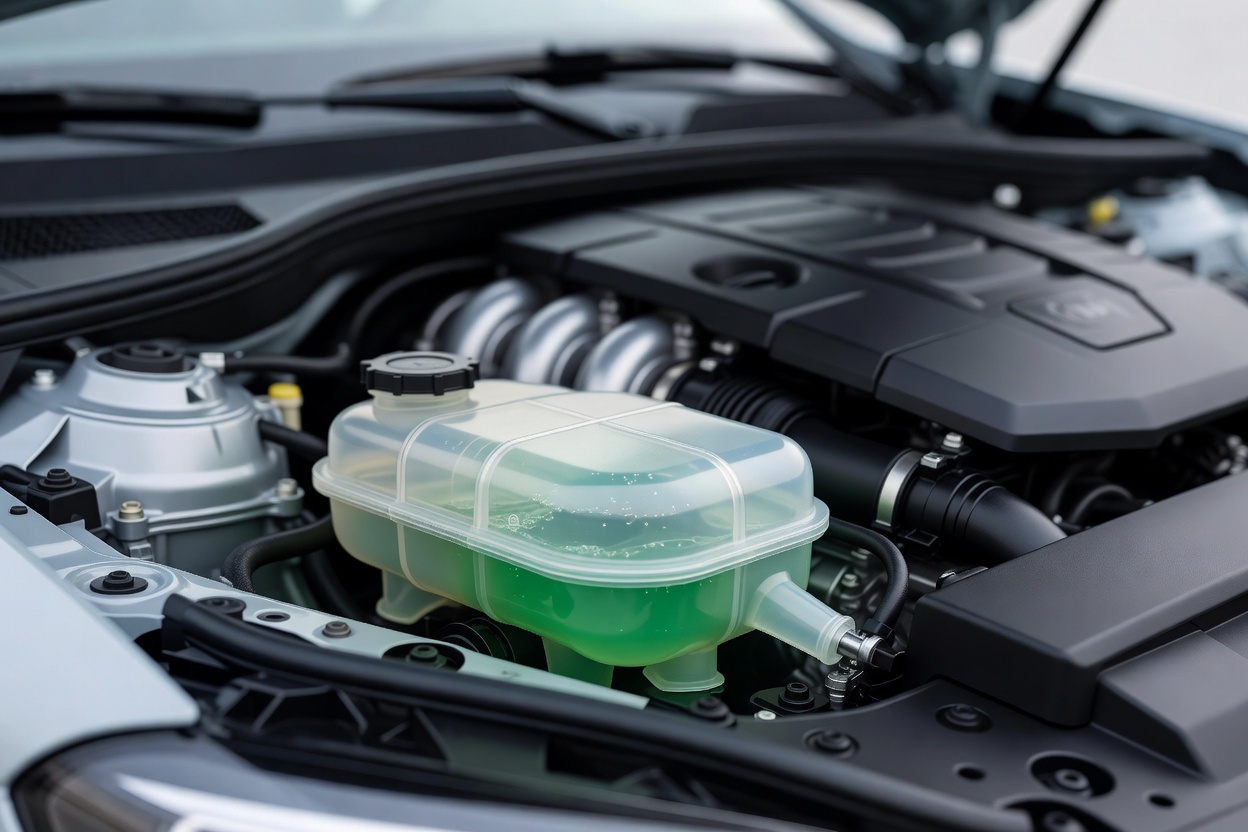
Most people know coolant as the coloured liquid that stops the engine freezing in winter. That is one of its jobs and arguably the least important of them.
Coolant is doing three things at once, and two of them matter every single day of the year. Understanding that explains why it has an interval, and why the colour on the bottle is not a styling choice.
Three jobs, not one
First, it moves heat. Water is excellent at carrying heat away from the engine to the radiator, which is the core function and the reason the system exists at all.
Second, it raises the boiling point and lowers the freezing point, so the system works across a much wider temperature range than water alone. That is the antifreeze part, and it protects in summer as well as winter: pure water in a hot engine would boil far sooner.
Third, and most overlooked, it protects against corrosion. An engine's cooling system contains aluminium, iron, copper, brass, solder, rubber and plastic all sharing the same fluid. Left in plain water those metals corrode and, worse, react with each other. The additive package in coolant is what stops that, and it is the part that runs out.
Why it expires even though it looks fine
The water and the glycol do not really wear out. The corrosion inhibitors do, gradually, as they do their job.
When they are depleted the fluid still cools and still resists freezing, so nothing about it looks or feels wrong. What it has stopped doing is protecting the metal, and from that point corrosion begins quietly inside the radiator, the heater matrix, the water pump and the engine itself.
That is why coolant has a replacement interval measured in years, and why skipping it does not produce an immediate symptom. The bill arrives later as a leaking radiator, a failed pump or a blocked heater.
The colours, and why they are not interchangeable
Colour is a dye rather than a specification, which is the single most common misunderstanding here. Two coolants of the same colour can be chemically different, and two of different colours can be compatible.
What actually differs is the inhibitor chemistry. Older technologies use inorganic additives that deplete relatively quickly. Newer organic acid formulations last much longer, and hybrid types sit between them. They are designed around the specific metals and gasket materials in the engines they were made for.
Mixing incompatible types is the expensive mistake. The additives can react and drop out of solution as a gel or sludge, which blocks the narrow passages in a radiator and heater matrix. That turns a fluid change into a flush and sometimes into replacement parts.
How to know which one your car needs
- Check the handbook first. It names the specification, usually as a manufacturer approval code rather than a colour.
- Check the expansion tank cap and any label near it, which often repeats the specification.
- If the history is unknown, treat the current contents as unknown too and have the system flushed rather than topped up with a guess.
- Buy on the approval code, not on the colour of the bottle or the shelf label.
- If you must add something in an emergency, plain water gets you a short distance, and it should be corrected properly afterwards rather than left.
That last point is worth taking seriously. Water dilutes both the freeze protection and the corrosion protection, so an emergency top-up quietly becomes a long-term problem if it is forgotten.
Concentrate or ready mixed
Coolant is sold both ways and either is fine, provided you know which you have bought.
Concentrate has to be diluted with the right proportion of water, and the ratio determines both the freeze protection and, at the extremes, how well it carries heat. Too weak and it freezes sooner than you expect; too strong is also worse at moving heat than a correct mix, which surprises people who assume more must be better.
Ready mixed removes the arithmetic and is the sensible choice for topping up. Use demineralised or deionised water for dilution rather than tap water, because the minerals in tap water are exactly what forms scale in the system.
What to watch for between changes
A glance at the expansion tank when you check the oil covers most of it.
- The level should sit between the marks when the engine is cold. A level that keeps dropping means a leak somewhere.
- The fluid should be coloured and reasonably clear. Rusty, brown or oily coolant is a reason to have it looked at.
- Anything resembling sludge or floating particles suggests mixed or degraded fluid.
- Crusty coloured deposits around hoses and joints under the bonnet mark a slow leak that has been drying.
- A heater that has become less hot than it used to be can indicate a low level or poor circulation.
None of that takes more than a few seconds, and it catches the slow problems while they are still cheap.
The short version
Change it at the interval in your handbook, buy it on the manufacturer's approval code rather than the colour, and never mix types on a guess. Use the right water if you are diluting concentrate.
It is one of the cheapest fluids on the car and it protects some of the more expensive parts on it, which makes it a poor place to save money.
Common questions
Is coolant the same as antifreeze?
Antifreeze is one of three jobs coolant does. It also carries heat away from the engine and, most overlooked, protects a system full of mixed metals against corrosion. The corrosion inhibitors are the part that depletes, which is why coolant has an interval.
Can you mix different coolant colours?
Colour is a dye, not a specification, so it tells you very little. What matters is the inhibitor chemistry, and mixing incompatible types can make the additives drop out as a gel that blocks a radiator or heater matrix. Buy on the manufacturer's approval code.
Why does coolant need changing if it looks fine?
Because the corrosion inhibitors deplete while the fluid still cools and still resists freezing. Nothing looks wrong, but the metal is no longer protected, and the bill arrives later as a leaking radiator, a failed pump or a blocked heater.
Can I top up with water?
In a genuine emergency it will get you a short distance, but it dilutes both the freeze protection and the corrosion protection. It should be corrected properly afterwards rather than left, which is the part that tends to get forgotten.
Should I buy concentrate or ready mixed?
Either, as long as you know which. Concentrate must be diluted correctly, because too weak freezes sooner than expected and too strong is actually worse at carrying heat. Use demineralised water rather than tap water, whose minerals form scale.
Read more like this
Servicing
Car Filters Explained: What Each One Does and When It Matters
Your car has four filters doing four unrelated jobs, and they are the cheapest parts on the service list. Here is what each does and what happens when it clogs.
Servicing
Do I Need Wheel Alignment? The Signs, and What It Actually Fixes
Do I need wheel alignment? The clearest evidence is not how the car drives, it is how the tyres are wearing. Here is how to read it before you pay for anything.
Servicing
How Often Should You Change Engine Oil? The Honest Answer
How often should you change engine oil? The interval in your handbook assumes a driving pattern most people do not have. Here is how to read it properly.
Need tyres or a service?
Search by registration or size, compare fitted prices from local specialists, and book with the price locked in.
Find tyres