
Diagnose it
Is My Tyre Illegal? How to Tell in Two Minutes
Is my tyre illegal is the question you ask standing next to the car, having just noticed something. Here is how to check tread, cracks, bulges and exposed cords, and what each one means for driving today.
8 lectura mínima
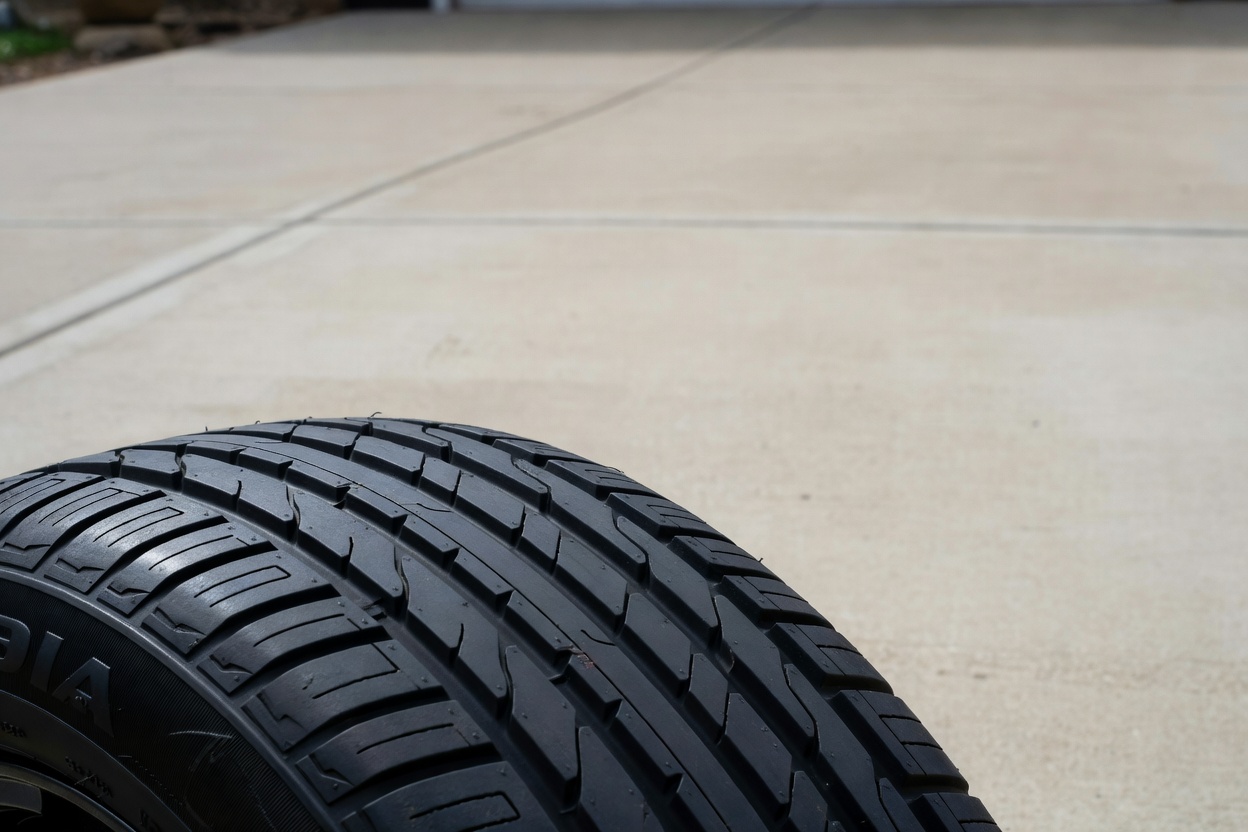
You are standing next to the car, you have noticed something about a tyre, and you want to know whether you can drive it today. Is my tyre illegal is the honest version of that question, and it has a specific answer for each of the four things people usually spot.
Every check below takes under two minutes and needs nothing but your eyes and a hand. What none of it does is replace someone looking at the tyre properly. Treat this as a way to know how worried to be, not as a verdict.
Tread depth: how bald is too bald
Every tyre has wear indicators moulded into the base of the main grooves, small raised bars set at the legal minimum for your market. Look along a groove: while the tread surface stands proud of those bars there is tread left, and when it is flush with them the tyre has reached the limit.
Check in several places, not one. The rule in most markets is about the central band of the tread and the whole circumference, so a tyre can be legal where you looked and finished a quarter turn further round. Roll the car forward a little and look again.
The uncomfortable part is that legal and safe are not the same line. Wet grip falls away well before the minimum, because the grooves exist to push water out from under the tyre and shallow grooves move less of it. Stopping distances in the wet lengthen considerably in the last couple of millimetres. Plenty of drivers replace earlier for that reason alone, and that is a judgement rather than a rule.
Cracks: which ones matter
Fine cracking across the sidewall or in the base of the tread grooves is usually age rather than damage. Rubber contains oils that keep it flexible, they migrate out over years, and the surface hardens and crazes. It happens whether the tyre is driven or parked, which is why a low-mileage car can have older-looking tyres than a high-mileage one.
Shallow surface crazing on an otherwise sound tyre is generally cosmetic. What matters is depth and location. Cracks deep enough to see into, cracks that follow a line rather than spreading as a web, or any crack where the rubber has opened up, mean the casing is compromised.
Check the age while you are there. A four-digit code in an oval on the sidewall gives the week and year of manufacture, so 2319 is the twenty-third week of 2019. There is no universal expiry date, but many manufacturers suggest inspecting anything past about five years and being wary past ten, regardless of tread.
A cracked sidewall cannot be repaired. Repairs are only permitted in the central tread area, and only within limits, which is why this one usually ends in a replacement rather than a fix.
Bulges: the one that is genuinely urgent
A bulge, sometimes described as an egg or a bubble in the sidewall, is different from everything else on this page. It is not wear and it is not ageing.
Inside a tyre is a casing of cords. When a car hits a pothole or a kerb hard, the sidewall can be pinched between the rim and the obstacle, and some of those cords snap. They are what holds the shape against the air pressure inside, so where they have gone, the sidewall pushes outwards. The bulge is the damage becoming visible.
The tyre may hold pressure and drive normally for a while, which is exactly what makes it dangerous. The weakened area is carrying load it was not designed to carry, and the failure when it comes tends to be sudden rather than gradual.
A bulge cannot be repaired, and it is not something to run to the end of the month on. If you have one, treat getting it replaced as this week rather than eventually, and drive gently and slowly until you do.
Exposed cords: the tyre is already finished
If you can see anything that is not rubber, the decision has been made for you. Steel, fabric or a different colour showing through means the tread or sidewall has worn or been damaged through to the layers underneath.
At that point the tyre is below any legal minimum and beyond any repair. Water gets into exposed steel and it corrodes, which weakens the casing further. This is a do not drive it further than you have to situation, and if it is on the car now, the spare or a call-out is the better option than a trip across town.
Worth noticing where it is showing. Cords exposed on one edge only usually mean the wheel alignment has been wearing that side away for months, so replacing the tyre without fixing the alignment simply starts the same process again.
Reading the wear pattern while you are down there
The shape of the wear tells you why, and that is worth more than the depth alone.
- Worn in the centre, edges fine: usually over-inflation, the tyre riding on its middle.
- Worn on both edges, centre fine: usually under-inflation, the tyre bowing in the middle.
- Worn on one edge only: usually alignment, and it will do it again to a new tyre.
- Wavy or scalloped patches around the tyre: often worn dampers letting the wheel bounce.
- Feathered, smooth one way and sharp the other when you run a hand across: usually alignment too.
None of these are things you can conclude with certainty from a driveway. They are what to mention when you book, because they change what gets checked first and can stop you paying for the same tyre twice.
So what do you do now
If you found exposed cords or a bulge, that is a call to a fitter rather than a plan for the weekend. If you found tread level with the wear bars, the tyre is at its limit and should be replaced before it goes below. If you were asking is my tyre illegal because of fine surface cracking on a tyre with plenty of tread and no other symptoms, note the date code and mention it at the next service.
And if you are unsure which of these you are looking at, that is a completely reasonable place to be. Tyre damage is genuinely hard to judge from a photograph, let alone a description, and any fitter will look at it. The two minutes you have just spent mean you can describe what you found rather than just saying something looks wrong, which is the difference between a useful conversation and a guess.
Preguntas frecuentes
How do I know if my tyre is below the legal limit?
Look for the small raised wear indicators in the base of the main grooves. While the tread stands proud of them there is tread left; when the surface is flush with them the tyre has reached the legal minimum for your market. Check in several places around the tyre, because it can be legal in one spot and not in another.
Are cracks in a tyre sidewall dangerous?
It depends on depth. Fine surface crazing is usually ageing, as the oils that keep rubber flexible migrate out over years, and on an otherwise sound tyre it is generally cosmetic. Cracks deep enough to see into, or that have opened up, mean the casing is compromised and the tyre needs replacing, since a sidewall cannot be repaired.
Can a bulge in a tyre be repaired?
No. A bulge means cords inside the casing have broken, usually from a pothole or kerb impact, and nothing can restore them. The tyre may hold pressure and feel normal, which is what makes it risky. It should be replaced promptly rather than monitored.
What does it mean if I can see wire through my tyre?
It means the rubber has worn or been damaged through to the steel belts underneath. The tyre is below any legal minimum, cannot be repaired, and the exposed steel will corrode. Do not drive further than necessary on it.
Is it worth replacing tyres before they reach the legal limit?
Many drivers do, and the reasoning is about wet grip rather than the law. The grooves clear water from under the tyre, and as they get shallower they clear less, so wet stopping distances lengthen well before the legal minimum. It is a judgement about how and where you drive rather than a rule.
Lee más como esto
Diagnose it
Burning Smell From Car? What Each One Usually Means
A burning smell from car vents or under the bonnet has a handful of likely causes, and they are not equally urgent. Here is how to tell which one you probably have.
Diagnose it
Car Air Conditioning Not Cold? What That Usually Means
Car air conditioning not cold any more? It rarely breaks suddenly. It fades, and the way it fades tells you whether this is a refrigerant job or something else.
Diagnose it
Car Pulls to One Side? Work Through It in This Order
When a car pulls to one side the causes run cheap to expensive in a predictable order. Here is how to work through them without paying for the wrong one.
¿Necesitas neumáticos o un servicio?
Busca por matrícula o tamaño, compara precios de instalación de especialistas locales, y reserva con el precio bloqueado.
Encuentra neumáticos