
maintenance
Liquide de frein : pourquoi il se change au temps
Le liquide de frein absorbe l'humidité de l'air. C'est la seule pièce d'entretien dont l'échéance ne dépend pas du tout de vos kilomètres.
9 min lezen
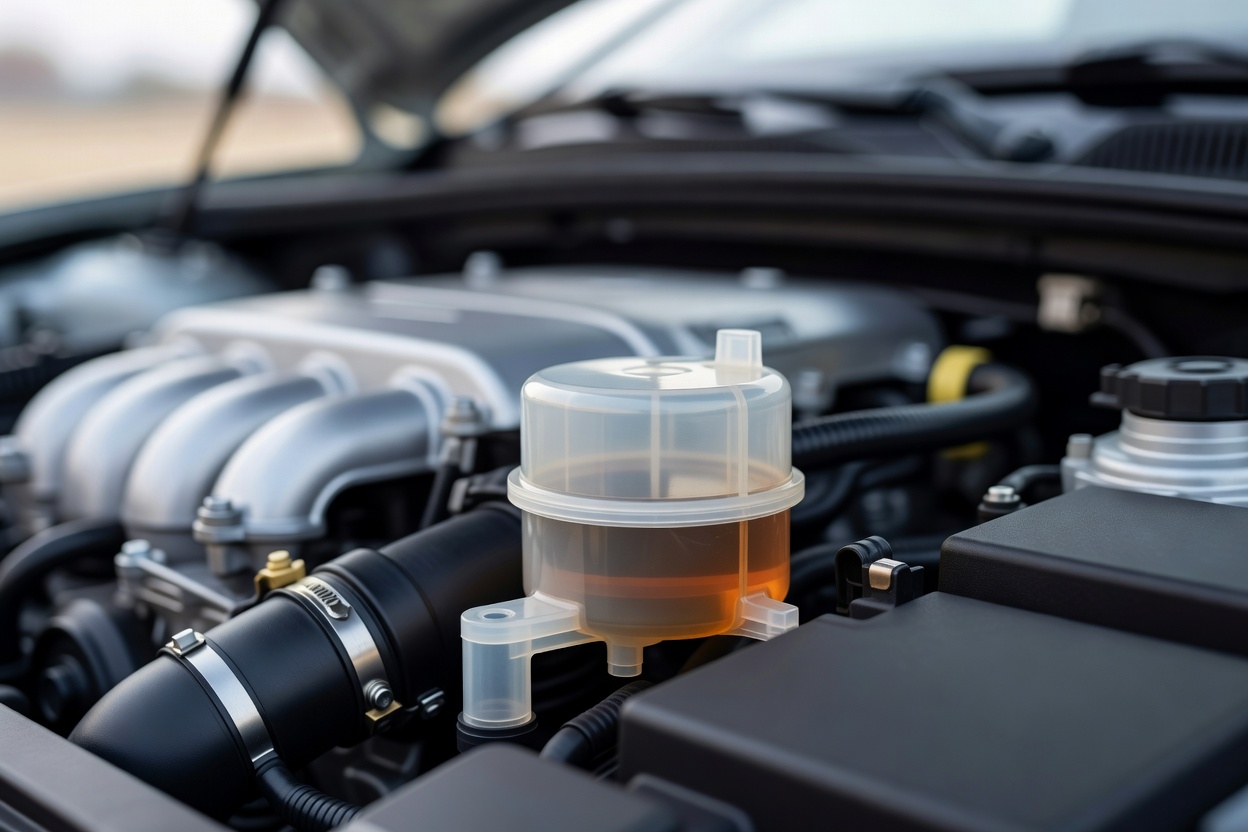
C'est le poste d'entretien le plus négligé de la voiture, et c'est le seul qui agisse directement sur la capacité à s'arrêter. Il ne prévient pas, il n'a pas de témoin, et il ne s'use pas au kilométrage.
Le liquide de frein se remplace au temps parce qu'il vieillit par l'air plutôt que par l'usage. Une voiture qui dort dans un garage y a droit exactement comme une voiture qui fait cinquante mille kilomètres par an.
Pourquoi le temps et pas les kilomètres
Le liquide de frein courant est hygroscopique : il absorbe l'humidité présente dans l'air, à travers les durites, les joints et le bouchon du bocal. Ce n'est pas un défaut mais une propriété voulue, car l'eau captée reste ainsi dispersée dans le liquide au lieu de se rassembler en gouttelettes qui rouilleraient le circuit de l'intérieur.
La contrepartie est que sa teneur en eau augmente inexorablement, de l'ordre de un à deux pour cent par an selon le climat. Au bout de deux ans, on est couramment autour de trois pour cent, et c'est le seuil à partir duquel les conséquences deviennent mesurables.
Ce que l'eau change, concrètement
Le freinage transforme l'énergie du véhicule en chaleur, et cette chaleur atteint le liquide dans les étriers.
Un liquide neuf bout à une température très élevée. Chargé à trois pour cent d'eau, ce point d'ébullition chute lourdement. Si le liquide bout, il se forme des bulles de vapeur, et la vapeur se comprime là où le liquide ne le fait pas : la pédale s'enfonce sans que rien ne freine.
C'est ce qu'on appelle le vapor lock, et il n'arrive jamais dans la circulation ordinaire. Il arrive dans une longue descente de col, avec un véhicule chargé, exactement au moment où l'on a besoin des freins et où l'on ne peut pas s'arrêter pour réfléchir.
Les symptômes, tardifs et discrets
- Une pédale plus longue qu'avant, qui descend un peu plus bas avant de mordre.
- Une sensation spongieuse plutôt que ferme, surtout à froid.
- Une perte d'efficacité progressive après plusieurs freinages appuyés successifs.
- Un liquide devenu brun sombre dans le bocal, alors qu'il est jaune paille à l'état neuf.
- Sur les véhicules récents, un fonctionnement erratique des aides au freinage, qui utilisent le même circuit.
Aucun de ces signes n'est fiable comme déclencheur, et c'est le fond du problème : le premier symptôme franc peut être l'absence de freins dans la descente. D'où une échéance calendaire plutôt qu'une surveillance.
Les normes, et celle qu'il ne faut jamais mélanger
Le bouchon du bocal porte une norme, généralement DOT 4 sur les véhicules récents en Europe, parfois DOT 5.1 ou une variante à basse viscosité pour les systèmes à régulation électronique.
DOT 3, DOT 4 et DOT 5.1 sont à base de glycol et sont miscibles entre elles, l'usage étant de respecter au minimum la norme prescrite par le constructeur. DOT 5 en revanche est à base de silicone, n'est pas hygroscopique et n'est pas compatible avec les précédentes.
Ne mélangez jamais du DOT 5 avec un liquide à base de glycol. La proximité des chiffres est trompeuse et l'erreur impose un nettoyage complet du circuit. Sur un véhicule de tourisme ordinaire, la réponse est presque toujours celle inscrite sur le bouchon, et il n'y a aucun bénéfice à s'en écarter.
Le contrôle et la purge
Un testeur mesure la teneur en eau en quelques secondes, et beaucoup d'ateliers le font gratuitement pendant une révision. C'est un chiffre plutôt qu'une impression, et il tranche la question.
Le remplacement s'appelle une purge : on pousse le liquide neuf depuis le bocal jusqu'à chaque étrier, dans l'ordre prescrit, en évacuant l'ancien et l'air. Sur un véhicule équipé d'ABS et d'ESP, la procédure passe souvent par l'outil de diagnostic pour actionner le bloc hydraulique, ce qui explique qu'elle ne soit pas un travail d'amateur sur une voiture moderne.
L'opération est rapide et son coût est sans rapport avec ce qu'elle protège. C'est probablement le meilleur rapport sécurité sur dépense de tout l'entretien automobile.
Rien d'extérieur ne vous le rappellera
C'est la raison de fond pour laquelle ce poste est oublié, et elle mérite d'être dite clairement : aucun mécanisme automatique ne vous y ramène.
Le contrôle technique vérifie l'efficacité du freinage sur banc et l'étanchéité visible du circuit. Il ne mesure pas la teneur en eau du liquide, donc un véhicule dont le liquide n'a pas été changé depuis huit ans peut passer sans la moindre remarque. Le tableau de bord n'a pas de témoin pour cela non plus, et le témoin rouge de frein signale un niveau bas ou le frein de stationnement, pas un liquide vieilli.
Autrement dit, la seule chose qui déclenche ce remplacement est quelqu'un qui y pense. C'est pourquoi il vaut la peine de le rattacher à un repère existant plutôt qu'à la bonne volonté : une révision sur deux, ou l'année du contrôle technique, peu importe lequel tant qu'il revient tout seul.
Et quand vous le faites faire, demandez la teneur en eau mesurée avant, notée sur la facture. Cela vous donne un point de départ pour la fois suivante et, accessoirement, cela vous dit dans quel état vous rouliez.
En pratique
- Tous les deux ans, sauf préconisation différente du constructeur, indépendamment du kilométrage.
- Demandez un contrôle de teneur en eau si vous ignorez la date de la dernière purge.
- Respectez la norme du bouchon, et au minimum celle prescrite.
- Ne complétez jamais avec un bidon ouvert depuis longtemps : le liquide absorbe l'humidité dans son emballage aussi.
- Un niveau qui baisse n'est pas une consommation : soit les plaquettes s'usent et le liquide remplit les étriers, soit il y a une fuite.
Le dernier point mérite d'être connu. Une baisse lente accompagne l'usure normale des plaquettes et se corrige à leur remplacement. Une baisse rapide, ou un niveau bas avec des plaquettes récentes, est une fuite jusqu'à preuve du contraire, et le circuit de freinage est le dernier endroit où faire un pari.
Veelgestelde vragen
Tous les combien changer le liquide de frein ?
Tous les deux ans en général, sauf préconisation différente, et indépendamment du kilométrage. Il vieillit en absorbant l'humidité de l'air, donc une voiture qui roule peu y a droit exactement comme une voiture qui roule beaucoup.
Que se passe-t-il si on ne le change pas ?
Sa teneur en eau monte d'environ un à deux pour cent par an et son point d'ébullition chute. En cas de freinage prolongé, le liquide peut bouillir : les bulles de vapeur se compriment, la pédale s'enfonce et le freinage disparaît, typiquement dans une longue descente.
Comment savoir s'il est à changer ?
Par un testeur de teneur en eau, en quelques secondes, souvent gratuit lors d'une révision. Les symptômes sont trop tardifs pour servir de déclencheur : une pédale plus longue ou spongieuse et un liquide devenu brun sont des signes déjà avancés.
Quelle norme choisir ?
Celle inscrite sur le bouchon du bocal, au minimum. DOT 3, DOT 4 et DOT 5.1 sont à base de glycol et miscibles entre elles. DOT 5 est à base de silicone et n'est PAS compatible : malgré la proximité des chiffres, un mélange impose un nettoyage complet du circuit.
Mon niveau baisse, est-ce grave ?
Une baisse lente accompagne l'usure des plaquettes, car le liquide remplit les étriers, et se corrige à leur remplacement. Une baisse rapide, ou un niveau bas avec des plaquettes récentes, est une fuite jusqu'à preuve du contraire et se fait contrôler sans attendre.
Lees meer zoals dit
maintenance
Filtre à air et les trois autres : à quoi ils servent
Une voiture a quatre filtres et trois d'entre eux coûtent presque rien. Le quatrième est celui qu'on oublie et qui coûte cher.
maintenance
Liquide de refroidissement : lequel, et pourquoi
La couleur ne veut rien dire. Ce qui compte est la norme, et mélanger deux normes coûte plus cher qu'une vidange du circuit.
maintenance
AdBlue : à quoi ça sert et que faire s'il est vide
L'AdBlue n'est pas un additif et ce n'est pas optionnel. Quand le réservoir se vide, la voiture ne redémarrera plus, et c'est voulu.
Heeft u banden of een service nodig?
Zoek op nummerplaat of maat, vergelijk de prijzen van lokale specialisten, en boek met de prijs vastgelegd.
Vind banden